Good resurfacing candidate
The frame is sound and reasonably flat, with spacing and support that match the chosen board system.

Often it can—but the framing condition, joist spacing, flatness, ventilation, fasteners, stair details, and manufacturer requirements must be checked before old boards are replaced. Composite boards do not correct weak or deteriorated framing.
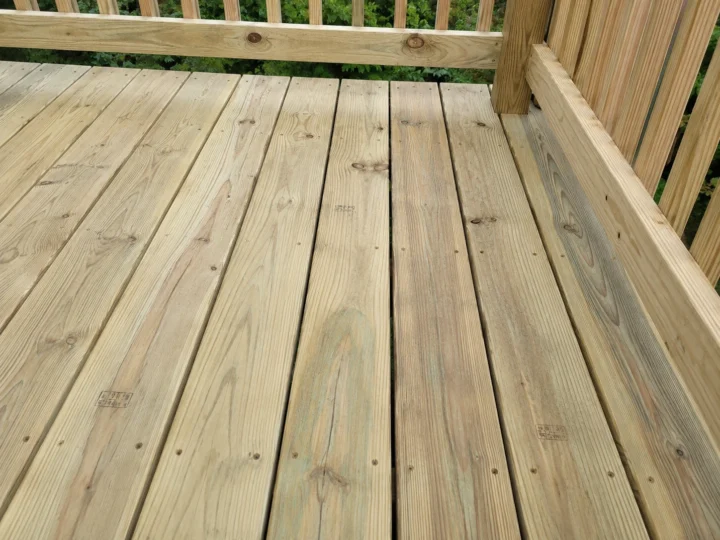
Composite boards can often be installed over an existing frame, but “the old boards came off cleanly” is not enough evidence. Premium decking is only a sound investment when the framing below is structurally serviceable, flat, correctly spaced, well drained, and detailed for the selected product and layout.
The frame is sound and reasonably flat, with spacing and support that match the chosen board system.
Localized repairs, added blocking, joist planing, flashing, or stair modifications can create a reliable base.
Widespread decay, major movement, unsuitable spans, or extensive geometry changes consume the value of reuse.
Worn surface boards may hide framing that is still serviceable—or rot around fasteners, beam connections, stair attachments, and the ledger. Decking should be removed far enough to inspect the structure before a final resurfacing scope is accepted.
Composite products vary in allowable joist spacing and stair-tread requirements. Picture-frame borders, diagonal layouts, breaker boards, and heavy features may require extra blocking. The selected product and layout should drive the framing plan.
When the frame is a suitable candidate for reuse, deck resurfacing can replace worn boards while retaining serviceable structural components. Learn more about deck resurfacing options
Composite expands and contracts differently than wood. Correct gaps, fasteners, ventilation, drainage, flashing, and fascia details help avoid buckling, trapped moisture, and uneven edges.
If the frame needs widespread repairs, has unsuitable geometry, or cannot support the desired layout economically, replacement may provide better long-term value than layering premium boards over a compromised structure.
These services are the closest match for the conditions and decisions covered in this guide.
Photos and checklists can help organize questions, but they cannot confirm concealed conditions, dimensions, fasteners, footing depth, structural capacity, or local requirements. If safety, load capacity, or the correct scope is uncertain, limit use as appropriate and have the property evaluated in person.
See how existing framing and new surfaces are evaluated together.